



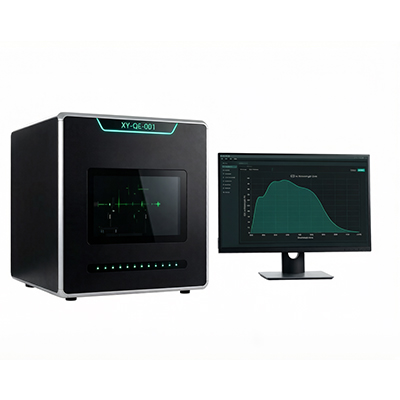
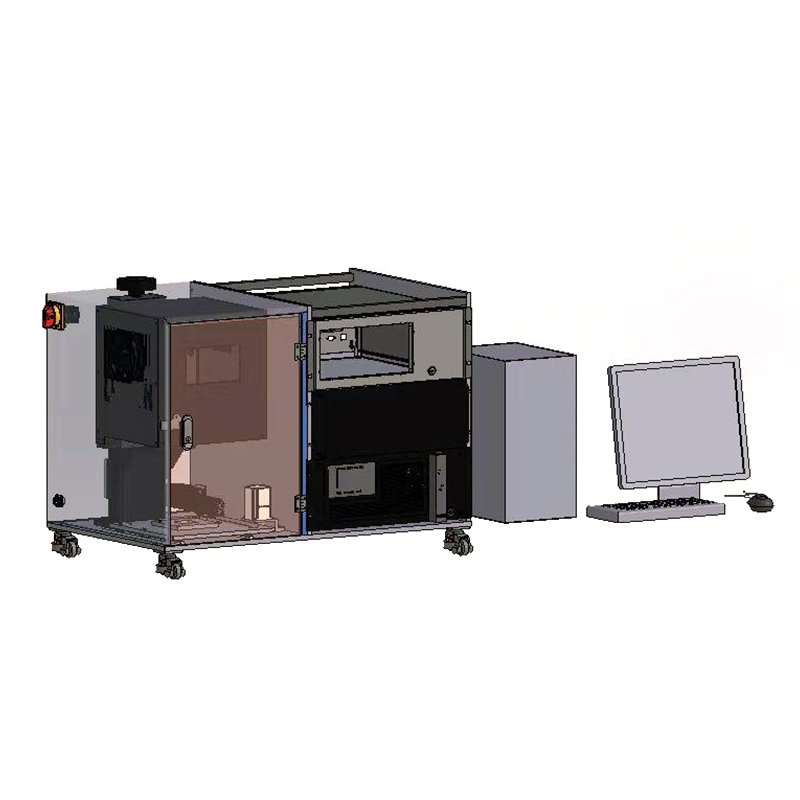
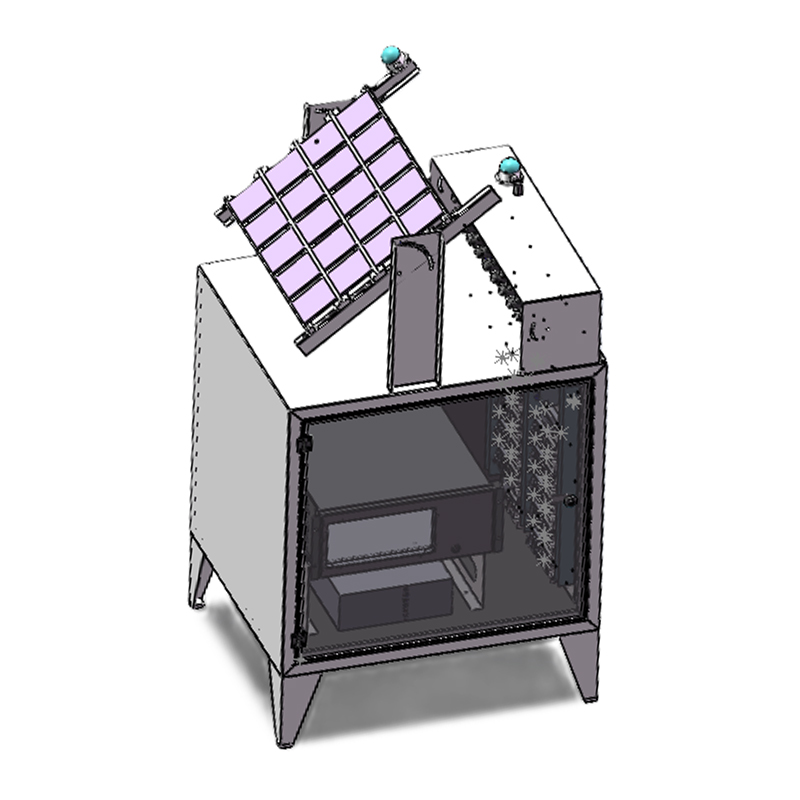
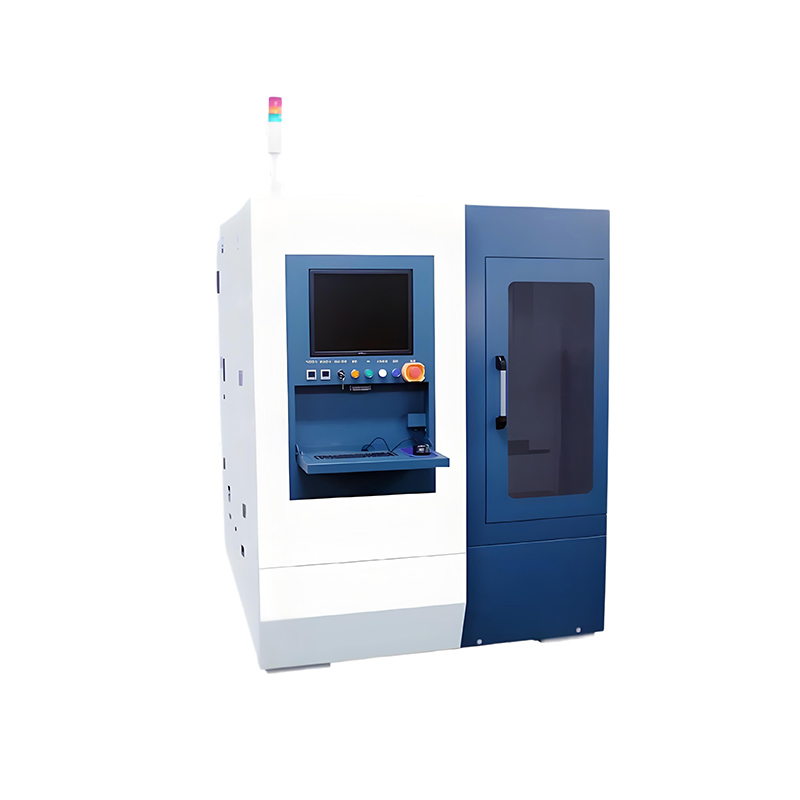

Perovskite solar cells (PSCs) have achieved a power conversion efficiency (PCE) of up to 26.95% under standard test conditions (STC). The current research focus has shifted from efficiency improvement to scalability and stability enhancement. Based on four years of outdoor data from Berlin, this study reveals significant seasonal performance fluctuations in PSCs: stable performance in summer but a substantial decline in winter (up to 30%). This phenomenon is attributed to the combined effects of multiple factors, including spectral variations, temperature coefficients, MPPT losses, and metastability effects. Maximum Power Point Tracking (MPPT) testing enables climate-characterized testing to accurately quantify the impact of metastability dynamics.
Experimental Design
In Berlin (a temperate low-irradiation climate zone), a glass-glass encapsulated p-i-n perovskite cell (structure: ITO | 2PACz | Cs₀.₁₅ FA₀.₈₅ PbI₂.₅₅ Br₀.₄₅ | C₆₀ | SnO₂ | Cu, bandgap 1.65 eV) was subjected to a 4-year outdoor exposure experiment
. The data acquisition system recorded spectral, temperature, and irradiance data every 5 minutes, calculated the average daily PCE, and periodically re-tested the cells under indoor STC conditions.
Overview of Outdoor Results
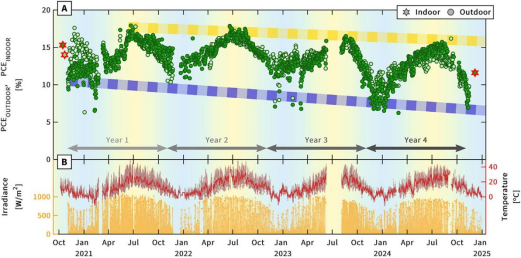
Summer PCE peaks: No degradation in years 1–2; cumulative decline of ≈2% by year 4.
Winter PCE troughs: Already 30% lower in the first winter, with a cumulative winter-to-winter decline of ≈40% over four years.
Indoor STC data: Linear degradation of 6%/year, but influenced by seasonal factors, outdoor summer-to-summer degradation was only 3%/year, while winter-to-winter degradation reached 9%/year.
Seasonal Influencing Factors
1. Spectral Variations
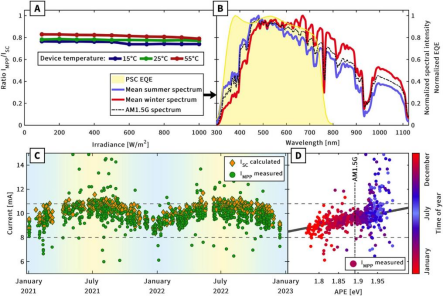
Spectral conditions are a critical factor affecting PSC performance. Outdoor spectra vary with seasons and atmospheric conditions, and PSCs are more sensitive to spectral changes due to their narrow spectral response range (≈300–800 nm). This study quantified the blue-light and red-light enrichment of spectra using the Average Photon Energy (APE). Results showed that summer spectra are blue-light enriched, while winter spectra are red-light enriched, leading to a current difference of up to 10% under identical irradiance levels.
2. Temperature Coefficient
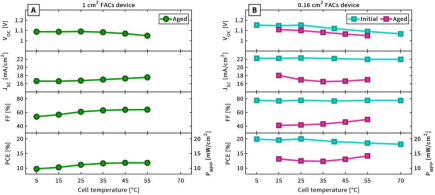
The temperature coefficient (γ) of PSCs is typically negative, indicating that performance decreases as temperature rises. However, as the cells age, the temperature coefficient of the fill factor (FF) becomes positive, resulting in better performance of aged PSCs under high summer temperatures. This contrasts sharply with traditional photovoltaic technologies (e.g., silicon solar cells).
3. J-V Hysteresis and MPPT Tracking Loss
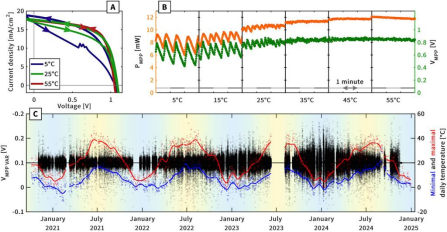
J-V hysteresis is a common phenomenon in PSCs that affects the accuracy of Maximum Power Point (MPP) tracking. Experiments showed that hysteresis significantly increases under aging and low-temperature conditions, reducing MPPT tracking quality. At 5°C, the MPPT tracking voltage fluctuation exceeded 35%, leading to significant energy loss. This effect is particularly prominent in winter, reducing the energy output of PSCs.
4. Perovskite Metastability Effects
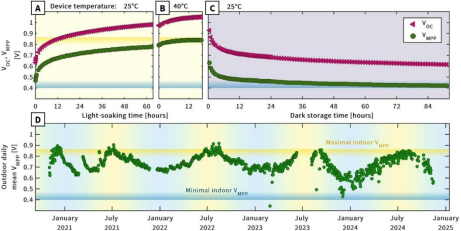
Metastability caused by the light-soaking effect (LSE) is a core distinguishing feature of perovskites compared to traditional photovoltaics. Experiments found that new cells reach light saturation within minutes, whereas aged cells require over 72 hours of continuous illumination to saturate. Additionally, temperature significantly influences LSE. Under low winter temperatures and light conditions, LSE remains unsaturated, resulting in insufficient voltage gain and performance degradation. This effect is a primary factor in the seasonal performance of PSCs.
The magnitude of seasonal variations in perovskite solar cells depends on climate and device characteristics. Compared to Berlin, regions closer to the equator exhibit smaller spectral changes, reducing current differences caused by spectral shifts. Additionally, low-temperature losses may be reduced in warmer climates. However, MPPT losses under aging and low temperatures may intensify in warmer climates. Metastability remains a key factor in seasonal performance, especially under low winter temperatures and light conditions where LSE unsaturated leads to performance degradation.
Key Takeaways: Seasonal variations significantly impact perovskite solar cell performance, with winter efficiency drops of up to 30% due to spectral shifts, temperature effects, MPPT losses, and metastability. MPPT testing is critical for quantifying these effects and optimizing stability.