Products

Featured products

Contact us

  • LC-LED-AAA-2400 Steady-State Solar Simulator
  • LC-LED-AAA-2400 Steady-State Solar Simulator
  • video

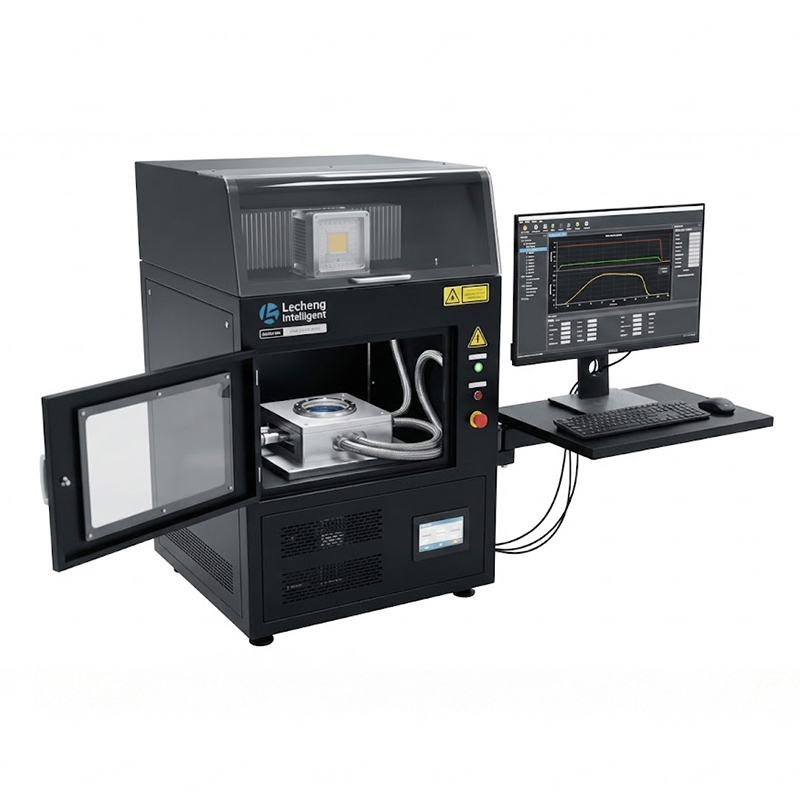
LC-LED-AAA-2400 Steady-State Solar Simulator

Class AAA performance meets IEC testing standards. 2400×1200mm large area supports full module testing. ±2% uniformity ensures highly accurate results. Stable 1000W/m² output improves testing consistency.
  • LECHENG
  • Jiangsu China

Precision Solar Module Testing for Large-Format PV Applications

The LC-LED-AAA-2400 Steady-State Solar Simulator is designed for photovoltaic module performance testing, reliability validation, and laboratory certification applications. The system complies with IEC 60904-9:2020 and supports IEC 61215-2:2021 MQT-2 testing requirements, making it ideal for solar module manufacturers, research institutes, and third-party testing laboratories.

Built for large-format photovoltaic modules, the simulator provides a full illumination area of 2400mm × 1200mm, allowing full-size module testing without segmented exposure. The system delivers stable 1000W/m² irradiance output, accurately simulating real sunlight conditions for performance validation.


Why Choose This Solar Simulator?

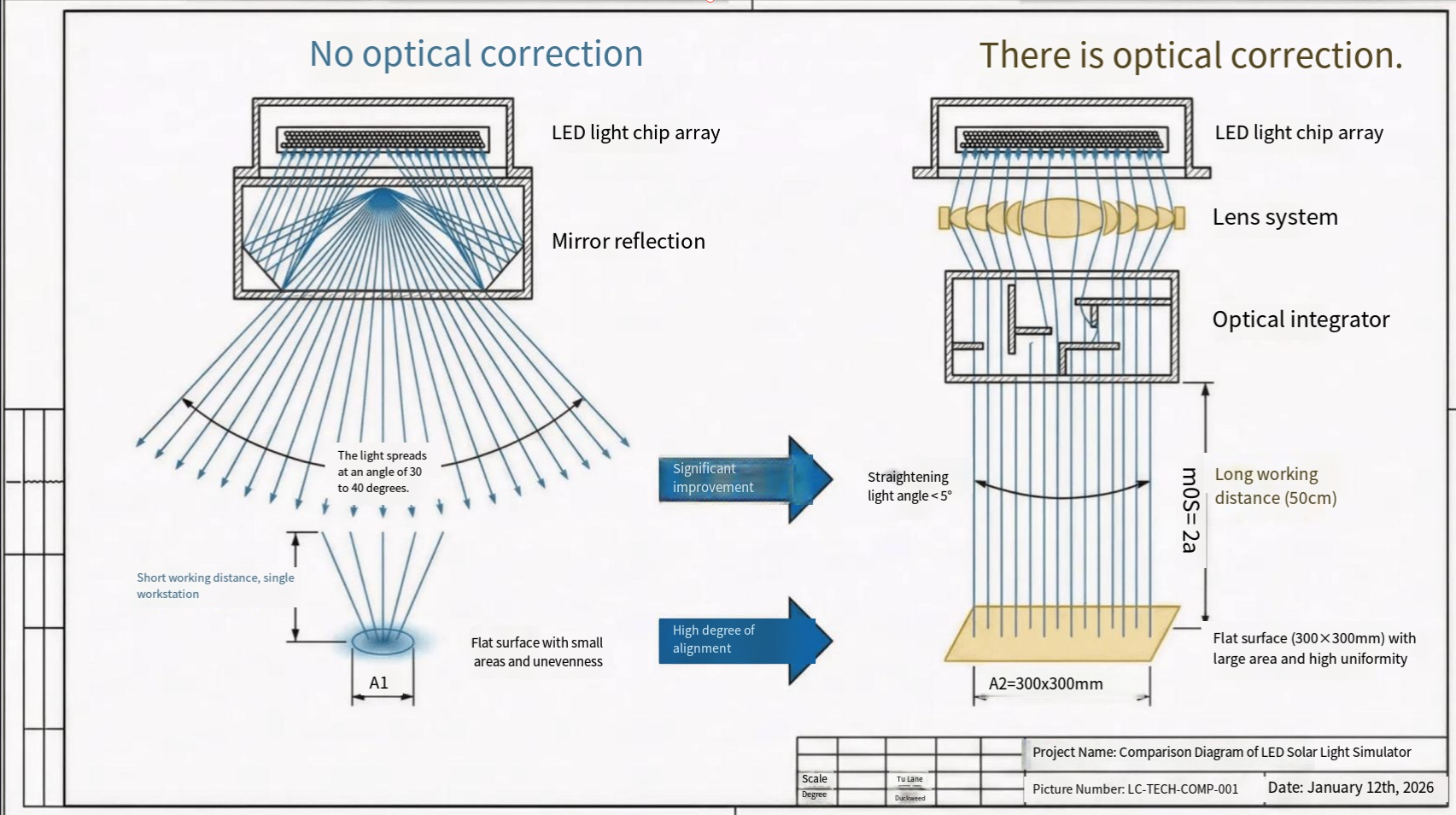
Traditional solar simulators often face challenges such as poor light uniformity, unstable irradiance, and heat interference. This system solves these problems through an optimized side-lighting optical structure.

Key Advantages:

  • Full-area simultaneous illumination

  • No tiled light source overlap issues

  • Reduced edge energy loss

  • Better temperature control stability

  • Suitable for large PV module testing

The system uses an advanced overlapping projection design that improves light uniformity while reducing energy waste.


Core Performance

ParameterSpecification
Solar Simulator ClassAAA
Irradiance Intensity1000W/m²
Illumination Area2400 × 1200 mm
Spatial Non-uniformity≤ ±2%
Temporal Instability≤ ±2%
Optical Path Length>10m

These parameters ensure reliable and repeatable test results for high-performance photovoltaic modules.
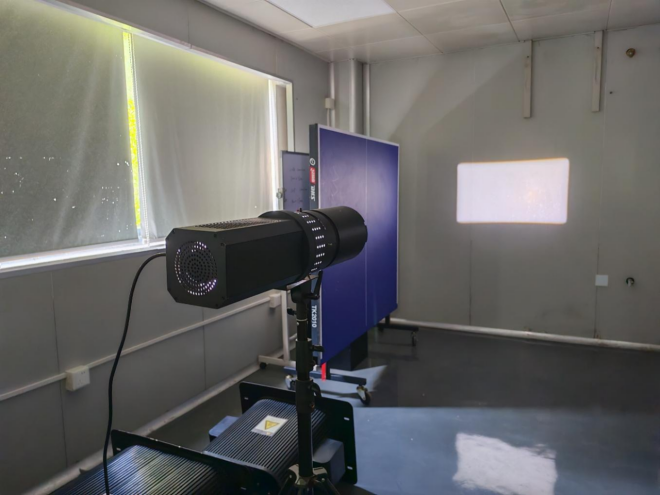
AAA Steady State Solar Simulator


Advanced Optical Design

The system adopts Metal Halide Lamp (MHL) technology with a wavelength range of:

300nm – 1200nm

This enables highly accurate spectral simulation under:

AM1.5G solar spectrum standards

The simulator achieves:

  • Class A spectral matching

  • Class A irradiance uniformity

  • Class A temporal stability

This makes it suitable for precision solar cell and module validation environments.


Temperature Control System

The simulator includes independent temperature control zones on both sides of the testing area.

Benefits include:

  • Stable testing temperature

  • Reduced environmental fluctuations

  • Better repeatability

  • Improved testing consistency

Standard testing temperature:

  • 25°C


Applications

The AAA Steady-State Solar Simulator is widely used for:

  • PV module certification testing

  • Solar panel R&D testing

  • Reliability validation

  • Laboratory testing

  • Production quality control

  • Research institutes

  • Third-party testing organizations


Standards Compliance

StandardCompliance
IEC 60904-9:2020Yes
IEC 61215-2:2021Yes
JIS C 8933Yes

Why Global Buyers Choose This System

✔ Large-format testing capability
✔ Stable long-term output
✔ Class AAA certification performance
✔ Better testing accuracy
✔ Designed for modern PV manufacturers


Get Accurate Solar Testing Results

Looking for a reliable solar simulator for module testing?

Contact us today for technical consultation and pricing.

Get Quote

  • How long does it take from equipment ordering to official production when cooperating with Locsen?

    The overall timeline varies depending on equipment specifications and production line scale. For standalone equipment, standard models require a 45-day manufacturing cycle, with total duration (including shipping and installation) of approximately 60 days. Customized equipment requires an additional 30 days based on technical requirements. For complete line solutions: • 100MW-level production lines require ~4 months for planning, equipment manufacturing, installation, and commissioning • GW-level production lines require ~8 months We provide detailed project schedules with dedicated managers ensuring seamless coordination. Example: A client's 1GW perovskite production line was completed 15 days ahead of schedule through parallel equipment manufacturing and facility construction.
  • Does Locsen offer suitable equipment and partnership solutions for startup perovskite companies

    Locsen offers a "Phased Partnership Program" specifically designed for perovskite startups. For the initial R&D phase, we provide compact pilot-scale equipment (e.g., 10MW laser scribing systems) bundled with essential process packages to facilitate technology validation and product iteration. During scale-up phases, startups qualify for upgrade benefits: • Core modules from pilot equipment can be traded in with value deduction toward production-line machinery • Optional technical collaboration including process development support and experimental data sharing This program has successfully enabled multiple startups to transition smoothly from lab to pilot production while mitigating early-stage investment risks.
  • Can Locsen's equipment handle perovskite solar cells of varying sizes? What is the maximum supported dimension?

    Locsen's laser equipment features exceptional size compatibility, capable of processing perovskite solar cells ranging from 10cm×10cm to 2.4m×1.2m. For oversized cell processing (e.g., 12m×2.4m rigid substrates), we offer customized gantry-type laser systems with multi-laser-head synchronization to ensure both precision and throughput. • Proven Performance: Successfully processed 1.2m×0.6m cells with industry-leading scribing accuracy (±15μm) and uniformity (>98%) • Modular Design: Swappable optical modules adapt to varying thicknesses (0.1-6mm) • Smart Calibration: AI-assisted real-time beam alignment compensates for substrate warpage
  • Does Locsen provide tailored laser solutions for all key production stages of perovskite solar cells?

    Yes, Locsen provides comprehensive laser processing solutions covering the entire perovskite solar cell production chain: P0 Laser Marking: For cell identification post-film deposition P1/P2/P3 Laser Scribing: Precision patterning of • Transparent conductive layers (P1) • Perovskite active layers (P2) • Back electrodes (P3) P4 Edge Isolation: Micron-level edge trimming to prevent short-circuiting Tandem Cell Modules: Dedicated laser etching systems for multi-material layer processing Our integrated equipment ecosystem ensures all laser processing requirements are met with: • ≤20μm alignment accuracy across layers • Thermal Affect Zone controlled under 5μm • Modular platforms supporting R&D to GW-scale production
  • What composition tolerance ranges do Locsen's tools support for variant perovskite formulations?

    Locsen's laser systems demonstrate exceptional adaptability to diverse perovskite compositions. • Preloaded Parameters: Optimized settings for mainstream formulations (e.g., FAPbI₃, CsPbI₃) in the laser recipe library enable instant operator access • R&D Support: For novel compositions (e.g., Sn-based perovskites), our team delivers: Custom wavelength/fluence calibration within 72 hours Performance validation ensuring <1% PCE degradation post-processing • Smart Compensation: On-board spectroscopy modules monitor reflectivity in real-time, automatically adjusting: Pulse duration (20-500ns) Beam profile (Top-hat/Gaussian) Energy density (0.5-3J/cm²) Technical Highlights: ▸ Tolerance for ±15% stoichiometric variation in Pb:Sn ratios ▸ Support for 2D/3D hybrid phase patterning ▸ Non-contact processing avoids cross-contamination

Related Products

40px

80px

80px

80px

Get Quote