


Thin-Film Solar Laser Processing Guide
How To Reduce Heat Affected Zone In Thin-Film Solar Cell Laser Processing
Heat affected zone is one of the most important quality factors in thin-film solar cell laser processing. Excessive thermal impact may damage functional layers, reduce insulation quality, increase defects and affect module yield. Buyers should evaluate laser source, pulse width, energy density, scanning strategy and process control before selecting equipment.
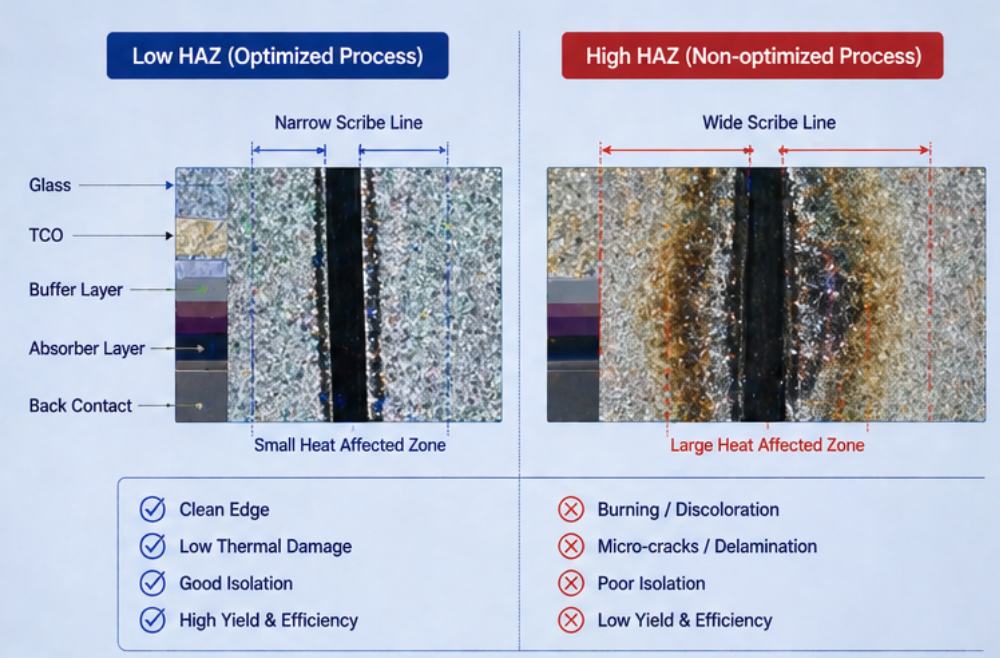
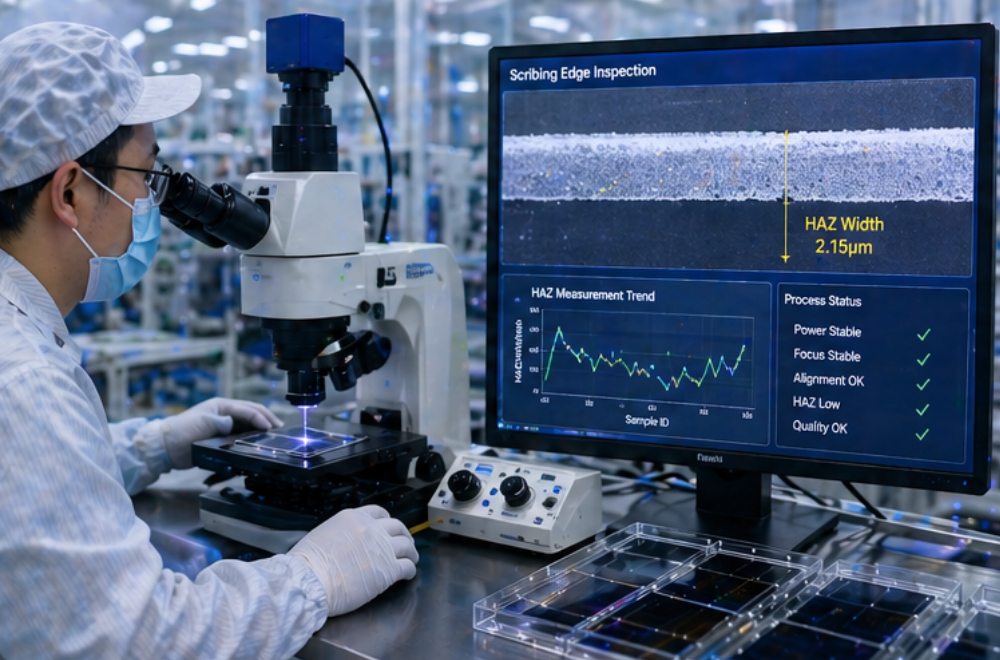
Get QuoteHeat affected zone, often called HAZ, refers to the area around the laser processing line where the material is thermally influenced but not directly removed. In thin-film solar cell laser scribing, this zone may appear as edge discoloration, micro-cracks, layer deformation, residue, delamination or reduced electrical performance. For perovskite, CIGS, CdTe and other thin-film photovoltaic structures, HAZ control is especially important because each layer is thin, sensitive and closely connected with adjacent layers. A clean scribing line with low thermal damage helps improve insulation, interconnection quality and long-term reliability. In laser scribing processes such as P1, P2, P3 and P4, the laser must remove the target layer without damaging surrounding materials. If too much heat spreads into nearby layers, the module may suffer from poor isolation, increased leakage current, higher resistance or lower conversion efficiency. Improves scribing edge quality Reduces micro-cracks and delamination risk Protects sensitive functional layers Improves insulation and interconnection stability Supports higher module yield and repeatability Laser wavelength determines how the target material absorbs energy. A wavelength with good absorption for the target layer can remove material more efficiently and reduce unnecessary heat transfer to adjacent layers. For thin-film solar cells, UV, green and infrared lasers may produce very different processing results depending on the material stack. Buyers should not assume that one wavelength is suitable for all solar cell structures. The correct choice should be based on TCO, absorber layer, transport layer, electrode material and actual sample testing. Pulse width has a direct effect on thermal diffusion. Shorter pulse lasers, such as picosecond or femtosecond lasers, can reduce heat accumulation and improve edge quality in demanding thin-film applications. Nanosecond lasers may also be effective when the process window is properly optimized. Energy density should be high enough to remove the target layer but not so high that it burns, melts or damages surrounding areas. Stable energy control is essential for reducing HAZ and maintaining repeatable scribing quality. A stable and well-focused laser beam helps create narrow and consistent scribing lines. Poor beam quality or unstable focus may increase line width, edge roughness and thermal damage. In thin-film solar processing, the optical path, focusing lens, motion platform and height control should be considered together. For pilot and production-level systems, automatic focusing, stable beam delivery and process recipe control can help reduce variation between batches. Laser processing strategy also affects HAZ. Scanning speed, pulse overlap, line spacing and processing sequence can either reduce or increase heat accumulation. A well-designed process strategy can remove the target layer cleanly while keeping thermal load under control. Buyers should ask whether the equipment supports flexible recipe settings, multi-parameter process development and stable motion control. These functions are important for optimizing different thin-film solar cell structures. Has the supplier tested samples with similar thin-film material stacks? Which laser wavelength is recommended for the target layer? What pulse width is suitable for the required edge quality? Can the supplier provide microscope images of scribing lines? What is the measured or estimated heat affected zone? Does the system support automatic focusing and stable beam delivery? Can process parameters be saved and repeated through recipes? Reducing heat affected zone in thin-film solar cell laser processing requires the right combination of laser wavelength, pulse width, energy density, beam quality, focusing stability and scanning strategy. Buyers should rely on process testing and real sample evidence instead of only comparing machine specifications. For perovskite and other thin-film photovoltaic applications, a low-HAZ laser process can help improve scribing quality, module yield and long-term reliability. Contact Lecheng Laser to discuss your thin-film solar cell material stack, laser scribing requirements and process optimization.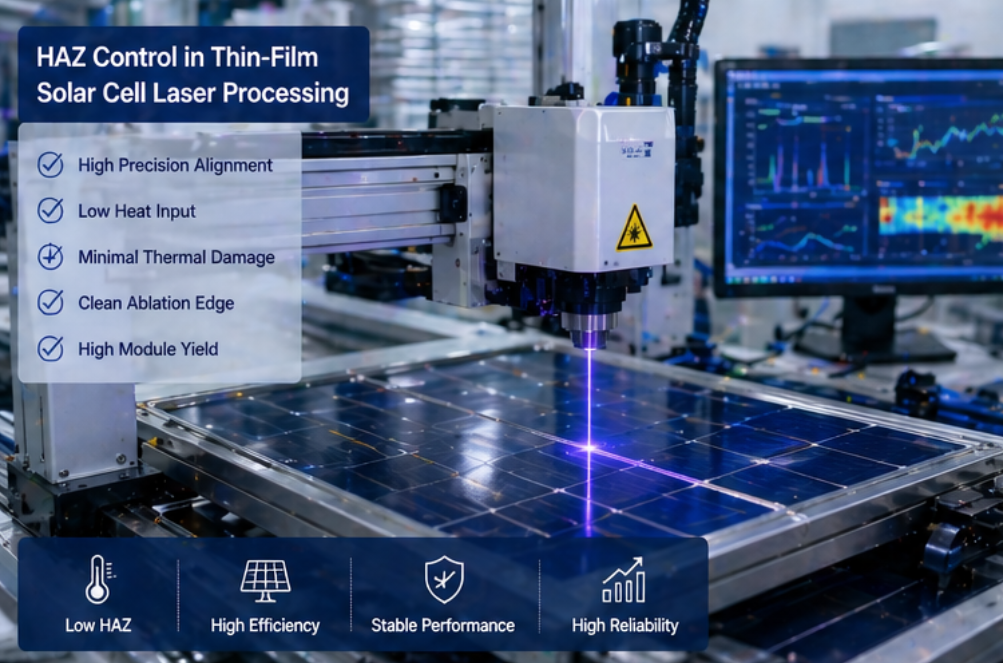
What Is Heat Affected Zone?
Why HAZ Reduction Matters In Solar Cell Manufacturing
1. Choose A Suitable Laser Wavelength
2. Optimize Pulse Width And Energy Density
Main Factors Affecting Heat Affected Zone
Factor Impact On HAZ Optimization Direction Wavelength Affects absorption and layer selectivity Match wavelength with target layer material Pulse Width Controls heat diffusion time Use suitable nano, pico or femtosecond laser based on process need Energy Density Too high energy increases burning and melting Find stable ablation threshold through testing Scanning Speed Low speed may increase heat accumulation Balance speed, overlap and removal quality Focus Quality Poor focus causes wider thermal impact Use stable optics and accurate focusing control 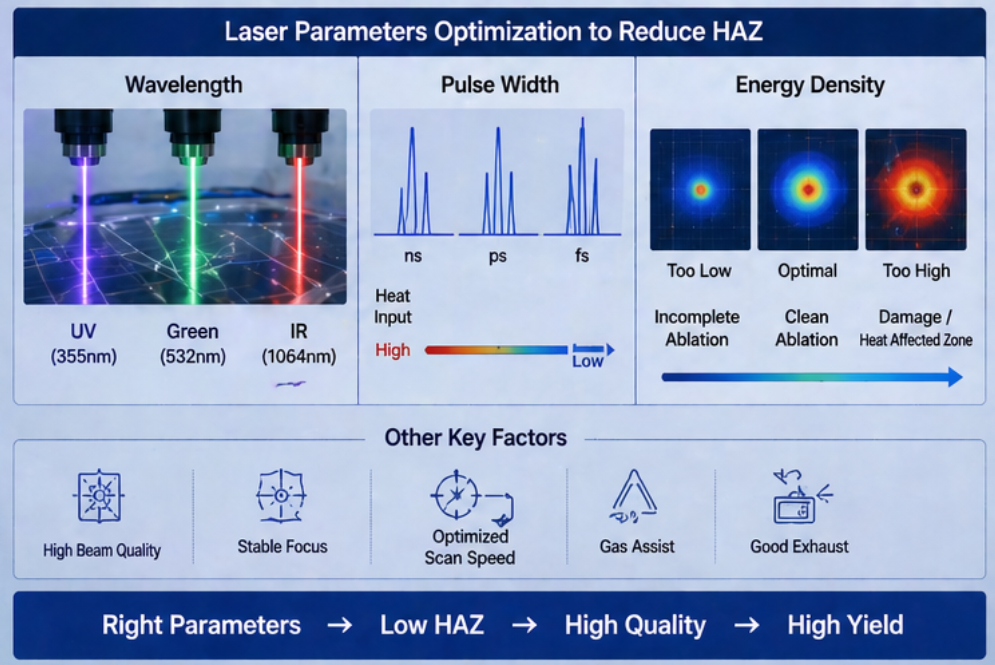
3. Improve Beam Quality And Focusing Stability
4. Control Scanning Strategy And Heat Accumulation
Buyer Checklist For Low-HAZ Laser Processing
Conclusion
Need Low-HAZ Thin-Film Solar Laser Processing?