


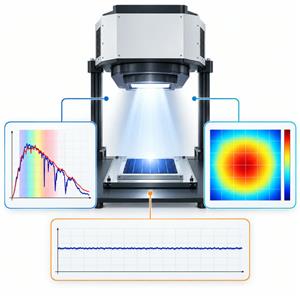
“Class AAA” is widely used in solar-simulator specifications, but the three letters do not describe one combined score. Each letter corresponds to a separate characteristic: spectral match, spatial non-uniformity and temporal instability, in that order. A Class AAA system reaches Class A in all three categories under the declared test conditions.
This distinction matters when comparing equipment. A simulator may be classified ABA, meaning Class A spectral match, Class B spatial non-uniformity and Class A temporal instability. Writing only “Class A” without stating the three characteristics can therefore be ambiguous.
The First A: Spectral Match
Spectral match evaluates how the simulator distributes optical power across defined wavelength intervals relative to a reference solar spectrum. For terrestrial PV testing, this is normally the AM1.5G reference spectrum used by the IEC 60904 series.
Under IEC 60904-9:2020, Class A spectral match requires the ratio in every evaluated interval to remain between 0.75 and 1.25. The final grade is determined by the worst interval and measurement location. Matching the total irradiance alone is not sufficient.
Spectral quality is especially important when the test device and reference cell have different spectral responses. Thin-film, perovskite and multijunction devices can show larger spectral mismatch errors than a silicon device measured with a matched silicon reference cell.
The Second A: Spatial Non-Uniformity
Spatial non-uniformity measures irradiance distribution across the defined test plane. IEC Class A requires a spatial non-uniformity value no greater than 2%.
The area must be stated with the class. A system may meet Class A over a small central region but not across a complete module-sized plane. For reliable testing, the active area of the device must remain inside the classified region at the calibrated working distance.
The Third A: Temporal Instability
Temporal instability measures how irradiance changes with time. IEC 60904-9:2020 separates short-term instability from long-term instability. Class A requires short-term instability no greater than 0.5% and long-term instability no greater than 2%.
Short-term variation can distort individual points during an I-V sweep. Long-term drift reduces repeatability between samples and matters during stabilization or MPPT testing. The test time window and synchronization method should therefore be included in the classification report.
IEC 60904-9:2020 Classification Table
| Class | Spectral Match | Spatial Non-Uniformity | STI | LTI |
|---|---|---|---|---|
| A+ | 0.875–1.125 | ≤1% | ≤0.25% | ≤1% |
| A | 0.75–1.25 | ≤2% | ≤0.5% | ≤2% |
| B | 0.60–1.40 | ≤5% | ≤2% | ≤5% |
| C | 0.40–2.00 | ≤10% | ≤10% | ≤10% |
What Changed with the A+ Class?
IEC 60904-9:2020 introduced Class A+ and expanded spectral evaluation to 300–1,200 nm. A+ spectral match requires every interval to remain between 0.875 and 1.125. A+ spatial non-uniformity is limited to 1%, while A+ short-term and long-term instability are limited to 0.25% and 1% respectively.
A+ is not obtained by simply measuring the traditional restricted range more tightly. The standard states that A+ classification is available only when spectral evaluation is performed over the extended wavelength range. A system meeting A+ in all three characteristics may be described as A+A+A+.
IEC and ASTM Ratings Are Not Identical
IEC 60904-9 and ASTM E927 both classify simulators using spectrum, spatial uniformity and temporal stability, but their editions, calculation details and limits should not be treated as interchangeable. ASTM E927-19 was reapproved in 2025. A quotation or acceptance report should identify the exact standard, edition, test plane and operating condition.
What an AAA Rating Does Not Guarantee
An AAA rating describes the light source at the test plane. It does not by itself guarantee a specific uncertainty for the measured solar-cell efficiency. The complete result also depends on:
Reference-cell calibration and spectral response.
Spectral mismatch correction.
Cell-temperature measurement and control.
Electrical contact resistance and four-wire connections.
I-V sweep rate, direction and synchronization.
Device area definition and aperture masking.
Transient response, hysteresis and light-soaking history.
Calibration traceability and uncertainty analysis.
IEC and ASTM sources both emphasize that classification alone does not state the electrical measurement error. A strong laboratory therefore combines a suitable simulator class with a documented measurement method.
Questions to Ask Before Ordering
Is the rating based on IEC 60904-9:2020 or another standard and edition?
Are the three classes reported separately?
What test-plane size and working distance were classified?
At what irradiance and source operating mode were measurements made?
Does the report include raw spectral data and an irradiance map?
Are STI and LTI both documented with their measurement windows?
Can performance be verified during factory and site acceptance testing?
What recalibration interval and reference equipment are recommended?
Select the Class for the Measurement Task
Class AAA is a sensible baseline for many research and production I-V measurements. Calibration laboratories, emerging wide-response devices and demanding uncertainty targets may benefit from A+ performance. Long-duration stability testing may place more emphasis on LTI, temperature control and feedback regulation than a fast production flash test.
Lecheng Intelligent Technology configures LED and steady-state solar simulation systems according to test area, spectrum, device type, I-V range and automation workflow. For class reports, acceptance testing or a complete I-V/MPPT solution, visit our photovoltaic solar testing equipment section or contact our engineering team.